
Internal mining
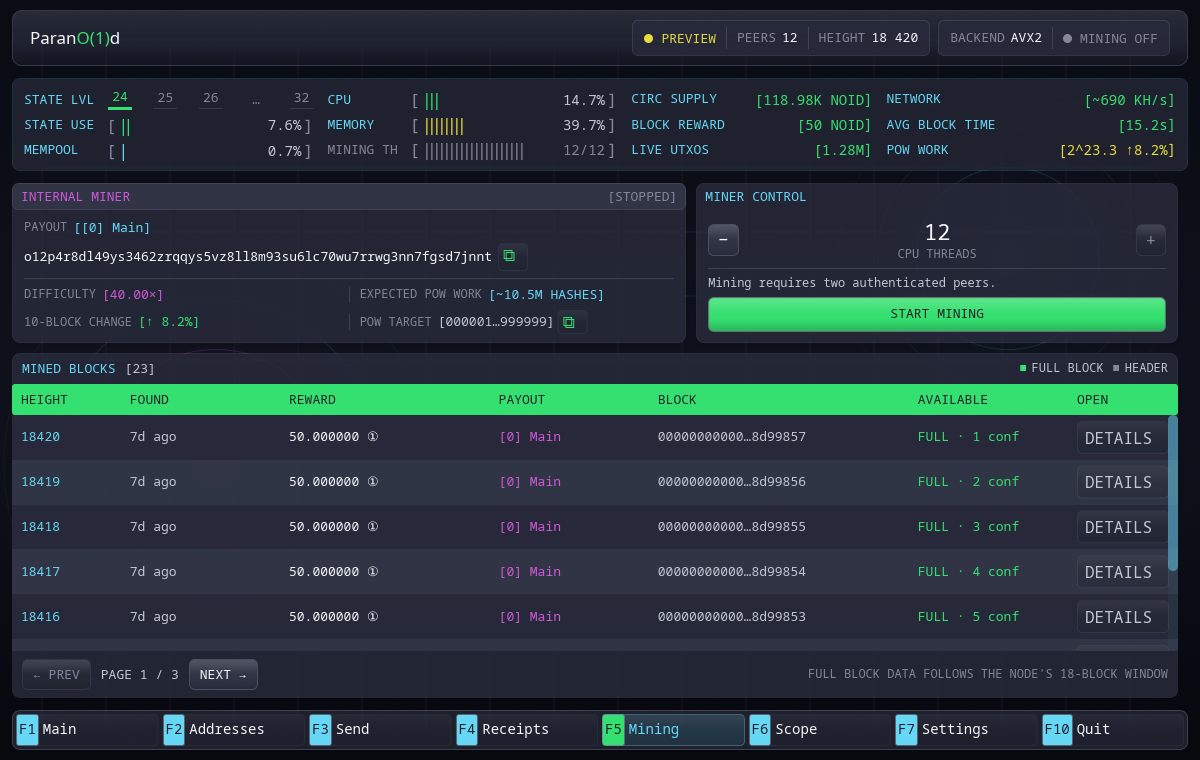
The Mining page controls the full node's built-in proof and PoW pipeline. Open
it with F5.
Requirements
Mining becomes available when:
- the node is synchronized;
- at least one authenticated peer is connected;
- the active or configured payout address is valid;
- the CPU passes the production hardware check.
The peer requirement prevents accidental mining on an isolated local view. Peers do not approve the block and cannot weaken local proof validation.
Controls
Choose the number of logical CPU threads, then select Start mining. The page shows:
- current payout address;
- difficulty relative to the genesis target;
- expected hash work at the current target;
- the change in expected work over the latest ten blocks;
- the current numeric PoW target, with a control to copy it in full;
- proof/mining state;
- locally mined canonical blocks.
Changing the active wallet address changes the payout for newly constructed templates. A template already being proved or searched remains bound to its original payout.
Shared CPU
Proof construction and nonce search use one shared CPU pool. The wallet does not run two independent all-core mining stages concurrently.
Local Send and Consolidate work receives priority. Mining yields, the wallet constructs and submits the authorization, and mining continues afterward.
Stop and exit
Stop mining asks the current worker to finish at a safe cancellation boundary. Closing the wallet also requests a graceful stop, flushes node state and then exits.
If a proof or database operation is at a non-interruptible boundary, shutdown may take several seconds. The full-window shutdown animation indicates that work is still progressing; force-killing the process risks an unnecessary database recovery on the next start.
Mined blocks
The lower table records primary rewards received by generated wallet addresses. It shows confirmation depth and whether complete block data remains inside the 42-block retention window. Permanent header data remains available afterward.
For server deployment, see Internal mining.