
Architecture
Parano1d moves each proof obligation to the place where its witness already exists. The wallet knows the spending secret. The miner has the public State witness. Full nodes need neither: they verify the resulting proofs and materialize the proven writes.
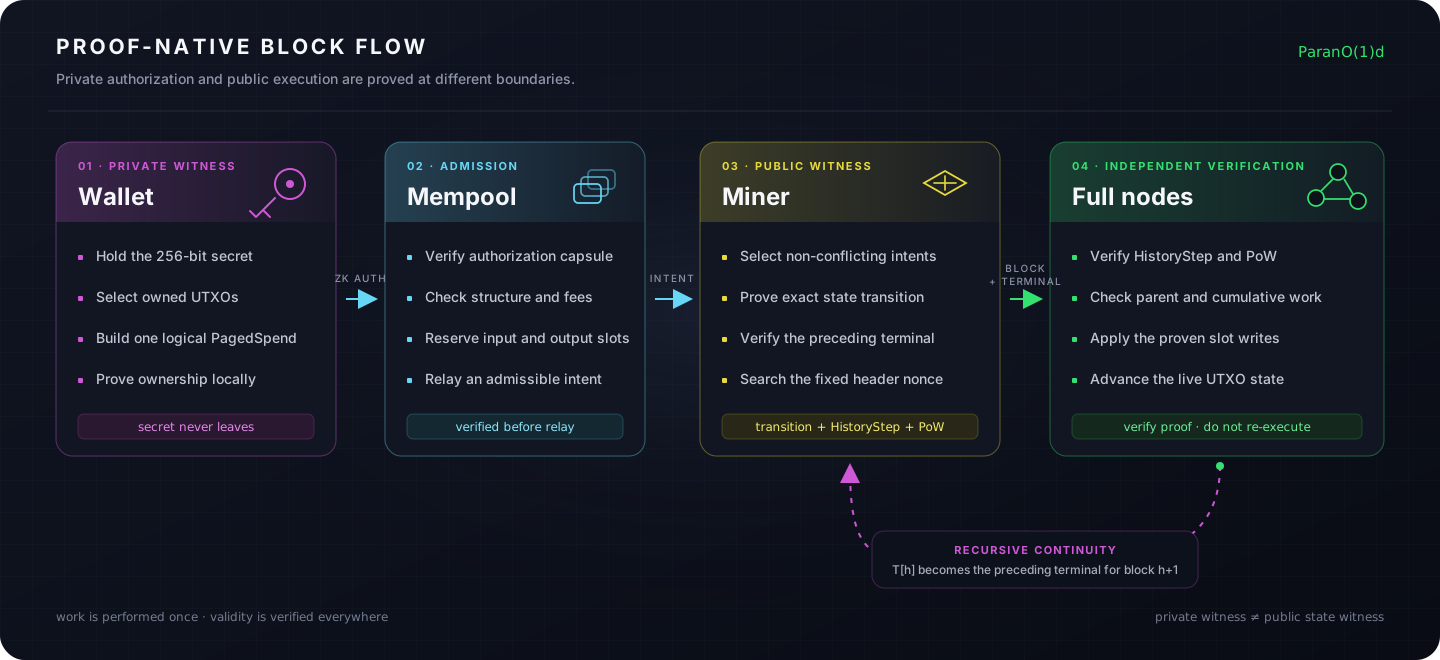
The proof boundary
The wallet and miner prove different statements.
The wallet proves knowledge of the 256-bit secret behind every input owner and binds that authorization to the complete logical transaction. It does not prove that an input is currently unspent because it does not need a current Merkle path.
The miner proves the public execution statement: inputs exist, output slots are
empty, values balance, fees follow consensus, the slot writes are exact and the
resulting UTXO root is correct. It also verifies the preceding HistoryStep
terminal inside the new proof.
This separation keeps private authorization local while allowing the public State witness to change between transaction construction and block inclusion.
| Stage | Receives | Establishes |
|---|---|---|
| Wallet | Secret and owned UTXOs | One randomized authorization bound to the logical transaction |
| Mempool | PagedSpend intent |
Capsule, structure, limits, fees and reservations are admissible |
| Miner | Accepted intents and Live State | Exact State transition and recursive continuity |
| Full node | Block and terminal | HistoryStep, PoW and canonical parent are valid |
Transaction and block flow
- The wallet selects live UTXOs and builds one logical
PagedSpend. - It constructs a fresh authorization capsule for
{logical_txid, input_owner}. - The mempool verifies the complete intent before storing or relaying it.
- A miner selects non-conflicting intents and computes the exact slot writes.
- The miner proves the block relation and preceding terminal, then searches the fixed Poseidon2b header nonce.
- Peers verify the atomic
{block, terminal}bundle and apply its proven writes to MDBX.
No peer re-runs wallet proving or miner execution. Invalid authorization cannot
be repaired by a miner, and hash power cannot make an invalid HistoryStep
acceptable.
Recursive continuity
Conceptually, terminal T[h] attests to three things:
- block
hsatisfies the public block relation; - its post-State root is the exact result of the proven writes;
- terminal
T[h-1]verifies, and its accumulator is the exact pre-State boundary for blockh.
The next block verifies T[h] inside its own relation. The chain therefore
accumulates validity recursively while keeping a fixed terminal shape.
Cumulative work still chooses between valid competing chains; recursion does
not replace proof of work.
State materialization
Verification produces a set of canonical slot writes. A full node applies those writes to its exact sparse UTXO vector rather than executing transaction logic again.
Slots live in 2^16-entry segments. Empty segments are virtual. Clearing the
last occupied slot removes a segment, while allocating an output reuses an
empty slot before extending State. A fresh creation_id prevents an old
reference from becoming valid when the same index is reused.
Nodes retain compact headers for cumulative-work comparison and the latest 42 canonical block bodies for ordinary synchronization and shallow reorgs. Older transaction bodies are not required by active consensus. Payment receipts preserve independently verifiable inclusion evidence after a body leaves that window.
Joining the network
A short gap is filled with retained block bodies and one verified recursive terminal at the suffix tip. For a deeper gap, the joining node stages headers and an authenticated snapshot of Live State. It verifies the cumulative-work chain, the finalized boundary and the matching boundary terminal before installing the State, then verifies one terminal for the recent suffix tip and applies its linked bodies.
The snapshot is not trusted State. It is a transport for State whose root and history boundary are authenticated by consensus.
Mining boundary
The miner proves all nonce-independent data first. PoW then searches only the 128-bit nonce of a fixed Poseidon2b header. This gives PoW one job: order valid State transitions.
An external miner receives an immutable, single-use template and returns only a nonce. Transaction selection, State transition, proof construction and block relay remain inside the node. Once issued, the template's payout, transactions and State root cannot be changed by the external worker.
Implementation map
| Component | Responsibility |
|---|---|
noid_tx |
Logical PagedSpend, transaction identifiers and authorization binding |
noid_mempool |
Intent admission, conflict reservations and relay policy |
noid_miner |
Transaction selection, State witness, block preparation and PoW |
noid_recursive |
HistoryStep relation, terminal verification and recursion |
noid_chain |
Consensus rules, MDBX State, headers, reorgs and snapshots |
noid_p2p |
GossipSub relay, discovery and synchronization protocols |
noid_node |
Runtime orchestration, wallet integration and shutdown |
noid_rpc |
Local node, wallet and external-mining interface |
For deployment rather than implementation details, continue with Run a node on Linux.