
Live State architecture
The canonical State is an exact sparse vector of UTXOs indexed by 32-bit slot number. A header commits to both its Merkle root and the counters required to interpret the vector:
state_root;log_slots, the current slot-domain exponent;active_slot_count;alloc_counter, the next creation identifier.
State begins with 2^24 possible slots and can expand one level at a time
to 2^32.
Slot lifecycle
An occupied slot records an amount, an owner and a creation_id. Spending
clears the slot to the canonical empty value. Allocation prefers empty
positions, so a later output can reuse the same numerical index.
The creation identifier makes reuse safe. An input must match both
slot_index and creation_id; a reference to an earlier occupant cannot spend
the replacement.
slot 9700063, creation 417  ── spend ──>  empty
empty slot 9700063          ─ allocate ─> slot 9700063, creation 894
The allocator counter is monotonic and committed in every header.
Segmented storage
The vector is divided into segments of 2^16 slots. A segment is materialized
only when it contains a live UTXO. Empty segments are virtual, and clearing the
last live slot removes the segment from physical storage.
This gives the node two useful views:
- exact raw segment columns in MDBX for wallet queries and transition materialization;
- a compact tree of segment roots for State authentication.
At the initial 2^24 domain, only 256 segment roots are needed. Together with
their upper tree nodes, the compact exact-root cache is under roughly 17 KiB.
Raw segment data can be hydrated or evicted independently while the committed
root remains exact.
Proving a transition
The miner gathers only the segments touched by the selected block. The public block relation proves:
- each input record matches the current slot;
- each output target is empty;
- no slot is used inconsistently;
- values and fees balance;
- every resulting segment root is correct;
- untouched branches carry through unchanged;
- the reconstructed global root equals the header's
state_root.
The accepted block exposes canonical writes. Other full nodes verify the
HistoryStep and apply those writes; they do not derive them by executing the
transactions again.
Expansion
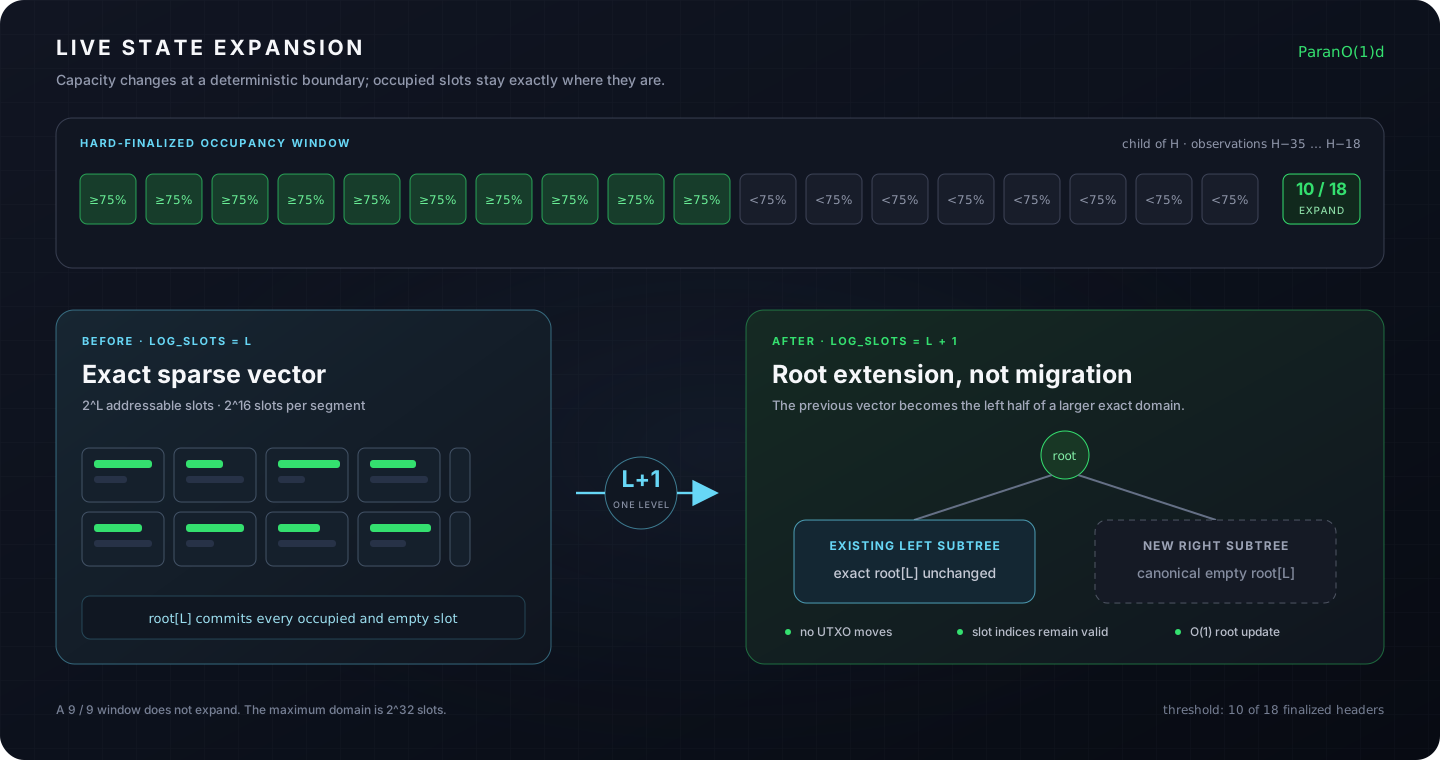
Expansion is based on an 18-header hard-finalized occupancy window. For a child
of parent height H, the window ends at H - 18. It is therefore unaffected
by the reorganizable suffix.
When at least 10 of the 18 finalized headers report occupancy at or above 75%,
the child increases log_slots by one. A 9/9 split does not expand.
The existing tree becomes the left child of a new root. An empty tree of equal depth becomes the right child:
new root
├── previous exact State root
└── canonical empty subtree
No UTXO moves, no segment is copied and slot numbers remain valid. Root update work is independent of the number of occupied slots.
Expansion also moves the issuance schedule to the next reward tier. It does not alter existing values or create a migration transaction.
State pressure and fees
Ordinary input and output work has a fixed fee component. Net-new live slots also pay a State-growth component whose multiplier rises with occupancy.
| Occupancy | Growth multiplier |
|---|---|
| Below 50% | 1× |
| 50% to below 75% | 2× |
| 75% to below 90% | 4× |
| 90% and above | 8× |
The growth component is burned. The remainder of the fee is claimable by the miner. A transaction that reduces or preserves the number of live slots pays no growth burn.
This prices the scarce resource directly: persistent State, not historical bytes that active consensus no longer needs.
Restart and reorganization
MDBX stores State changes transactionally. For recent blocks, bounded undo records contain the exact preimages and counters needed to roll State backward. The node retains 36 blocks of undo data while consensus permits a maximum 17-block canonical reorganization.
Restart does not reconstruct State from genesis. The node opens the persisted State, checks its canonical metadata and resumes from the current terminal.
See State transition for normative rules and Synchronization for authenticated State transfer.