
Proof stack
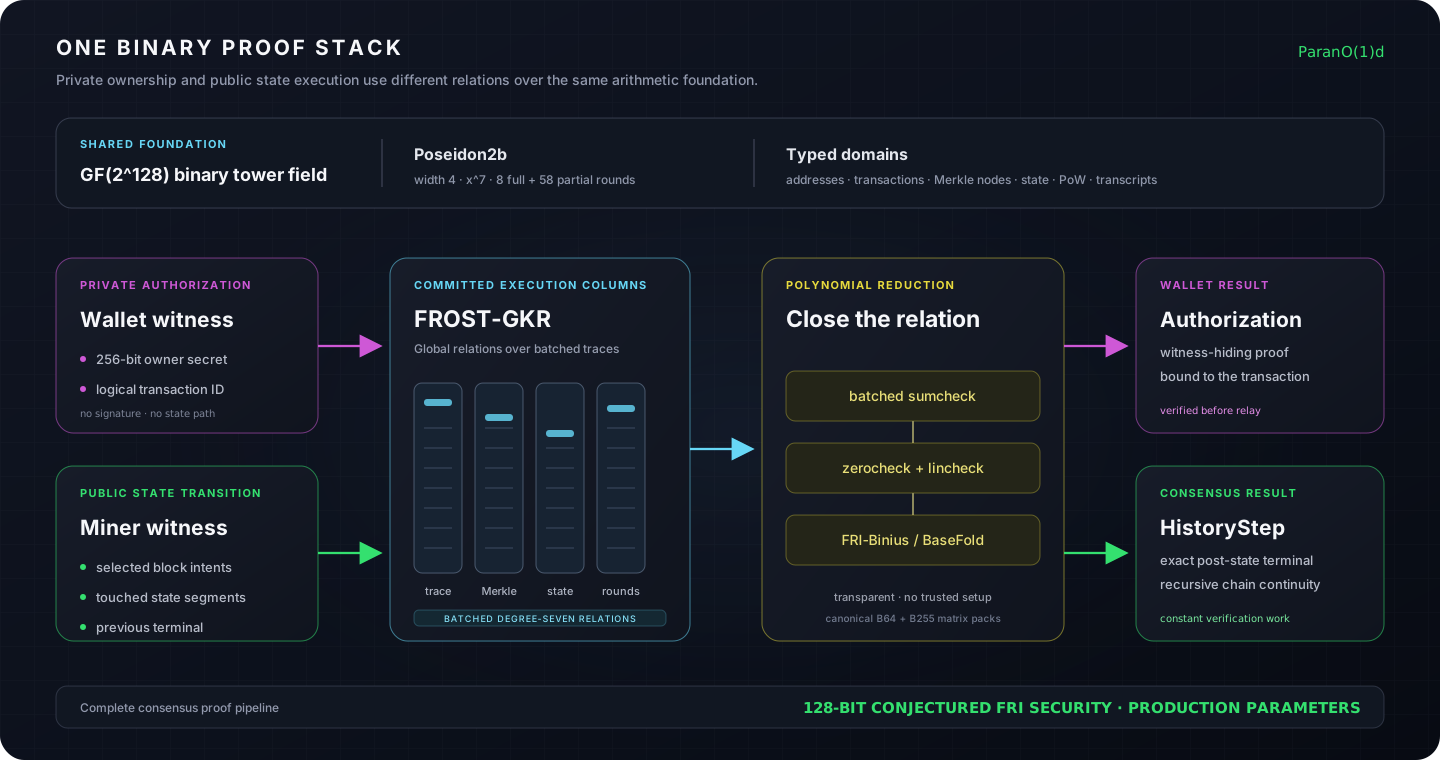
Parano1d uses one binary arithmetic stack for ownership, State transitions,
Merkle relations, recursive continuity and proof of work commitments. The
committed trace field is the binary tower field GF(2^128). The production
wide-challenge layer uses its quadratic extension GF(2^256).
Poseidon2b
Poseidon2b is the common permutation:
| Parameter | Value |
|---|---|
| State width | 4 field elements |
| S-box | x^7 |
| Full rounds | 8 |
| Partial rounds | 58 |
Typed domain tags separate addresses, physical pages, logical transactions, Merkle nodes, State commitments, block identifiers, PoW digests and proof transcripts. Sharing a permutation does not mean sharing a hash domain.
FROST-GKR
The protocol expresses batched Poseidon2b executions and Merkle paths as direct degree-seven relations over shared Boolean hypercubes. It is the committed- column reduction used by Parano1d, not a layer-by-layer replay of a circuit.
The reduction keeps the multilinear-extension and sumcheck machinery of GKR while replacing recursive circuit-layer descent with global relations over the execution trace. Shared columns let many permutations and paths be checked without paying for an independent constraint sumcheck for every instance.
Closing the relation
The downstream pipeline combines:
- batched sumcheck;
- zerocheck;
- lincheck;
- FRI-Binius/BaseFold over the binary field;
- one joint
GF(2^256)transcript for the three Link and six Block recursive regions.
The resulting proof system is transparent: it requires no trusted setup. The released binaries embed authenticated B25 and B255 matrix packs, including their expected digests. A build using a different pack cannot silently present it as the canonical relation.
Wallet authorization
The wallet proves knowledge of the 256-bit preimage behind input_owner,
bound to the logical transaction ID. The proof is freshly randomized and
witness-hiding. It contains no State path.
The serialized authorization has a 92,696-byte worst-case bound. The wire format permits up to 256 KiB so decoding remains explicitly bounded while leaving room for the canonical proof object.
HistoryStep
The block prover establishes the complete public transition and verifies the previous terminal inside the new relation. The next terminal therefore binds:
previous validity
        +
current block relation
        +
exact post-State
Proof size and terminal verification do not grow with chain height. Permanent headers remain outside recursion for proof-of-work accumulation and fork choice.
Security accounting
The production wide-challenge profile uses 65 wallet queries and 133 History queries. Its current security results are:
| Security statement | Production result |
|---|---|
| Target FRI security | 128 bits |
| Provable Block–Tiwari FS-FRI security | 127 bits |
| Conjectured Block–Tiwari FS-FRI security | 127 bits |
| Sequential ideal-QROM half-success boundary | 64.707407428576 bits |
| NIST Post-Quantum Cryptography Category | Category 1 |
| Dominant Category 1 gate-depth floor | 173.391078499301 bits |
The Block–Tiwari values measure classical random-oracle FS-FRI expected work.
The Category 1 result concerns the separate end-to-end from-genesis
invalid-State game and is conditional on the fixed Poseidon2b delta, batch
gate-depth price and scalar gate-charge premises stated in the theorem.
Production constants, reductions and exact calculations are in
noid_soundness.
For claim boundaries and non-proof assumptions, see Security model. Implementation crates are mapped in Workspace.